

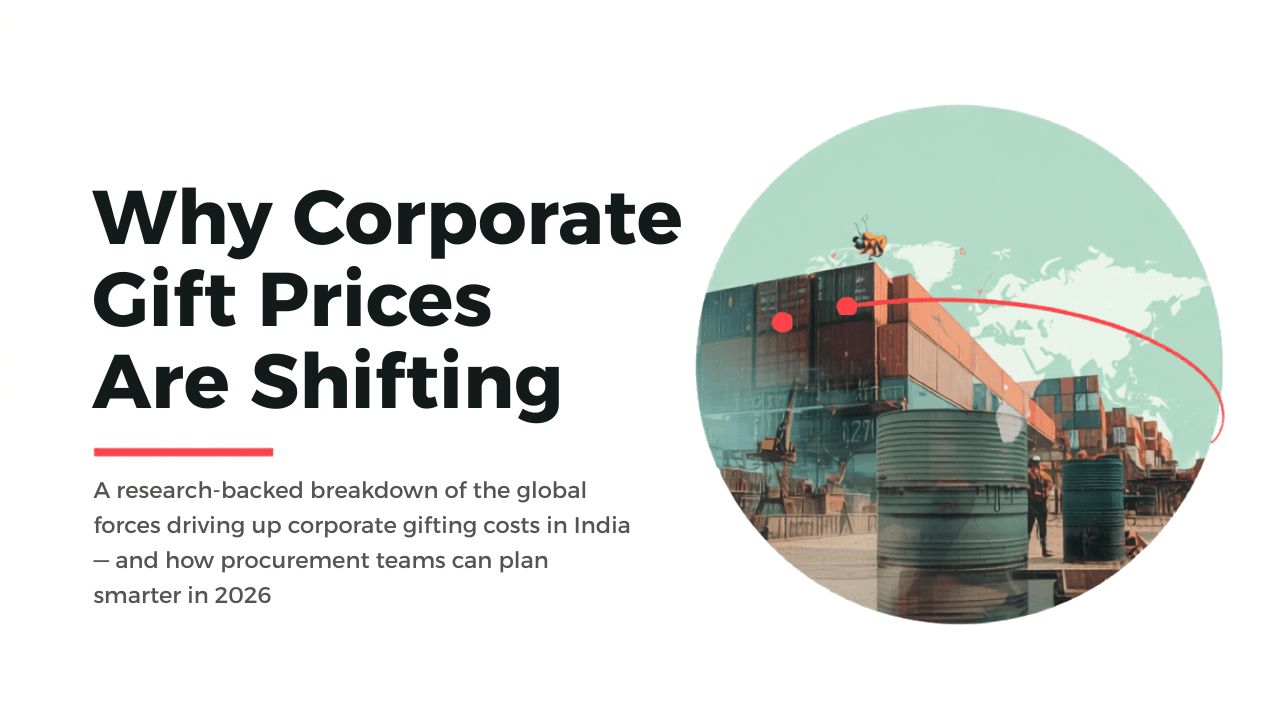
If you've noticed that your corporate gifting budget doesn't stretch as far as it did two years ago, you're not imagining it. And it's not just inflation.
A perfect storm of geopolitical conflict, escalating trade tariffs, and structural changes in how manufacturers manage their supply chains is quietly rewriting the rules of product pricing — and India's ₹14,000 crore corporate gifting industry is firmly in the path of it.
At OffiNeeds, we don't believe in sending vague "prices may change" notices. We believe you deserve to understand exactly what is happening, where it is coming from, and what it means for your gifting calendar. So we did the research.
The Big Picture: Three Forces Converging at Once
Pricing in the corporate gifting world doesn't change in isolation. It responds to global events — and right now, three major forces are converging simultaneously. Understanding them is the first step to making smarter procurement decisions.
Force 1: The Iran–Israel–US War and the Strait of Hormuz Crisis
This is the most significant and most immediate factor. On February 28, 2026, the United States and Israel launched coordinated airstrikes on Iran under "Operation Epic Fury," targeting military facilities, nuclear infrastructure, and key leadership. Iran's response was swift: missile and drone attacks on US military bases across the Gulf, and IRGC warnings that effectively shut the Strait of Hormuz to commercial shipping.
Here is why this matters to you as a procurement professional in India:
The Strait of Hormuz carries 20 million barrels of crude oil and 20% of global LNG every single day. When it is disrupted, it is not just an energy problem — it is a manufacturing problem, a logistics problem, and ultimately a product-pricing problem. Energy costs sit at the foundation of every factory, every courier, every packaging line.
"The current crisis is the greatest global energy security challenge in history." — Head, International Energy Agency (IEA), March 2026
India depends heavily on Middle Eastern oil imports. When energy costs rise by 25%+, they pass through every factory running machines, every truck delivering goods, every packaging facility sealing your branded kits. Higher energy = higher manufacturing cost = higher gifting cost. It's not immediate, but it's inevitable — typically with a 6–12 week lag.
Force 2: US Tariffs on Indian Goods — A Direct Hit on the Gifting Supply Chain
Even before the Iran war escalated, India's manufacturing sector was already absorbing a major cost shock. In August 2025, the Trump administration raised total US tariffs on Indian goods to 50% — combining a 10% baseline duty, a 25% reciprocal tariff from April 2025, and an additional 25% levy.
While these are tariffs on Indian exports to the US, they have a direct domestic ripple effect. Manufacturers of textiles, apparel, packaging, and tech accessories — all core to corporate gifting — face reduced export margins, compressing their ability to absorb input costs. The price pressure flows inward.
"Some product lines will simply become unviable overnight." — Ajay Sahai, Director General, Federation of Indian Export Organisations (FIEO), August 2025
According to the Global Trade Research Initiative (GTRI), India's textiles sector — which supplies a significant portion of branded apparel, tote bags, and fabric-based gift products — is bracing for a 70% collapse in exports to the US, endangering hundreds of thousands of jobs and disrupting domestic manufacturing capacity in the process.
Force 3: AI-Driven Lean Inventory — The Silent MOQ Squeeze
This one is less visible, but equally impactful for procurement teams. Manufacturers across Asia are rapidly adopting AI-powered inventory management systems. According to McKinsey, these systems are helping vendors reduce inventory holdings by 20–30%.
On the surface, that sounds efficient. But for buyers, it translates to something very specific: tighter minimum order quantities (MOQs), less buffer stock, and premium pricing for rush or smaller-volume orders.
The AI in supply chain market is valued at $14.49 billion in 2025 and growing at a 22.9% CAGR. This isn't a fringe trend — it's now standard operating procedure for most mid-to-large manufacturers. If you're placing orders at the last minute, you're competing for a shrinking pool of available production capacity.
Which Gift Categories Are Most Affected?
Indicative impact index based on energy exposure, import dependency, and tariff sensitivity.
What This Means for India's Corporate Gifting Market
India's corporate gifting market is on a strong growth trajectory — valued at ₹14,000 crore in 2025 and projected to nearly double to ₹27,000 crore by 2030, with companies increasing per-employee gifting budgets from ₹2,500 to ₹4,000 in just a few years.
But here is the tension: budgets are rising, yet per-unit value is eroding. Every rupee of gifting budget is buying less than it was 18 months ago — because input costs are rising faster than procurement budgets are growing. The gap between what companies want to spend and what they actually need to spend is widening.
The organisations that will navigate this well are those that treat gifting procurement the way they treat any other strategic category: with advance planning, vendor partnerships, and consolidated purchasing.
4 Ways to Protect Your Gifting Budget Right Now
Based on our analysis of current market conditions, here is what we recommend to every procurement and HR team planning their H2 2026 gifting calendar.
- 01 Plan 60–90 days ahead. With oil above $100/barrel and shipping insurance costs surging, vendor pricing revisions are already being scheduled. Booking requirements now locks in current rates before the next cost cycle hits.
- 02 Consolidate orders across departments. AI-lean inventory at manufacturers means tighter MOQs. Aggregating requirements across HR, admin, and marketing teams qualifies for better per-unit pricing and priority production slots.
- 03 Explore category alternatives. Premium kits and tech accessories carry the highest risk exposure right now. Stationery and select apparel remain comparatively insulated — often with equivalent brand impact at lower cost.
- 04 Ask about forward pricing agreements. For annual programmes — long service awards, onboarding kits, wellness hampers — rate-lock agreements with trusted vendors insulate you from mid-year energy cost transmission into goods pricing.
A Final Word: Transparency Over Price Surprises
At OffiNeeds, we have been in the corporate gifting business for over 20 years. We have seen inflationary cycles, freight disruptions, and raw material volatility before. What we know from experience is this: the companies that plan early always get more value per rupee than those who scramble at the last minute.
We are sharing this research not to alarm, but to inform. If you are planning your Diwali gifting, year-end awards, or Q3 employee recognition programmes, the best time to start those conversations is now — before pricing revisions work their way through the supply chain.
Our team is ready to give you a transparent, no-pressure consultation — current pricing, category recommendations, and honest lead-time realities. No surprises. Just smart planning.
Ready to plan your gifting calendar before prices move again?
Talk to our team for a free consultation on your upcoming gifting requirements — with transparent pricing and category alternatives tailored to your budget.
Get a Free Consultation →Sources & References
- CSIS: "The Iran Conflict Is Sending Oil Prices Soaring — What Happens Next?" March 2026
- World Economic Forum: "The Global Price Tag of War in the Middle East" March 2026
- Al Jazeera: "Iran War Threatens Prolonged Impact on Energy Markets" March 2026
- Congress.gov CRS Report: "Iran Conflict and the Strait of Hormuz" March 2026
- Wikipedia: "2026 Strait of Hormuz Crisis" — April 2026
- J.P. Morgan Asset Management: "Economic and Market Implications of the Israel-Iran Conflict"
- NPR: "U.S. Tariffs Take Effect on India, Threatening $48.2B in Exports" August 2025
- KPMG India: "U.S. Tariff Shifts — Tariff Revisions and Their Impact on India" 2025
- McKinsey: "Harnessing the Power of AI in Distribution Operations"
- ChocoCraft Industry Research: "Corporate Gifting Industry in India 2025–2030"
- IMARC Group: "India Gifting Market Size and Forecast 2025–2033"
- Precedence Research: "AI in Supply Chain Market Size to Surpass USD 192.51B by 2034"


