

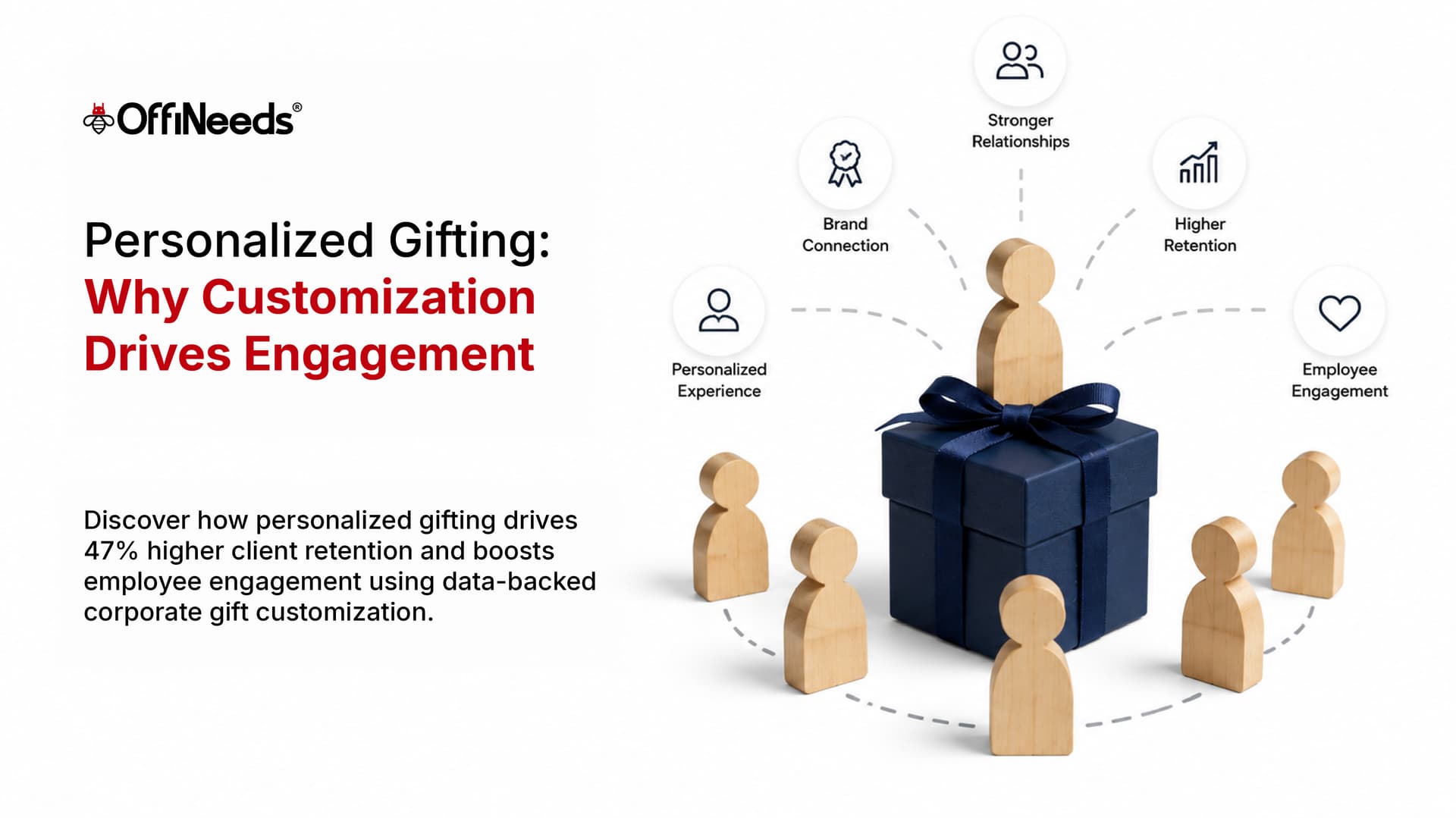
Key Takeaway: Personalised gifting is a strategic tool that directly impacts business outcomes. Companies with strong emotional brand connections see a 306% increase in customer lifetime value, per Motista research. In 2026, corporate gift customisation drives measurable retention and engagement when executed with recipient-specific data.
Generic corporate gifts are a wasted budget line. A 2025 Snappy survey found that 67% of employees say a meaningful gift increases their job satisfaction for up to six months. The global corporate gifting market will hit $956.93 billion in 2026, and organisations that still ship mass-produced items are losing both money and goodwill.
Personalised gifting is a performance strategy, not a nice-to-have. The gap between companies that customise and those that don't shows up in retention data, client renewal rates, and employee Net Promoter Scores. Most procurement teams still default to catalogue ordering without recipient data, leaving significant value on the table.
This guide will break down why corporate gift customisation beats generic programs, what trends are shaping 2026, and how to build a program that delivers actual ROI.
Why Is Personalised Gifting Essential for Business Growth in 2026?
Personalised gifting transforms standard transactions into lasting business partnerships by building emotional connections that generic merchandise cannot replicate. Companies with emotionally connected customers generate 306% higher lifetime value over an average of 5.1 years, compared to 3.4 years for satisfied-only customers.
That 306% figure is often cited loosely, so here is the real context: Motista’s study measured emotional connection to brands across categories, not gifts alone. But the mechanism is identical. Personalised gifting is one of the most direct ways to trigger that emotional response in a B2B or employer-employee relationship, because a physical gift creates a sensory and emotional anchor that digital touchpoints cannot.
High-performance organisations now view corporate gift customisation as a core part of business development. It is a line item that pays for itself through higher renewal rates, stronger referral pipelines, and better employer brand scores. The companies that still default to generic swag are competing with one hand behind their back.
The Financial Impact of Individualised Recognition
An 80% majority of corporate gift buyers reported that gifts directly improved their relationships with clients and employees, according to a Coresight Research survey of 300 corporate gift buyers. That finding matters because it puts a human validation number on what many procurement teams dismiss as a “soft” expense.
The ROI of gifting becomes clearest in contract renewal cycles. When a client receives executive gifting that mirrors their specific interests or professional challenges, the perceived value of the partnership rises. A branded notebook means nothing. A high-quality item selected based on a conversation about their hobby creates a memory. The difference between those two experiences is the difference between a vendor and a preferred partner.
“Emotionally connected customers are 52% more valuable than those who are simply satisfied,” noted Harvard Business Review in its research on brand loyalty drivers. That dynamic holds in corporate relationships where personalised gifting acts as the bridge from transactional to relational.
Moving Beyond Generic Swag
Roughly 40% of standard branded merchandise still ends up in landfills. That is a waste of budget and a brand risk. When a recipient throws away your logo item within a week, your company name is associated with disposability.
Modern customised swag must prioritise utility and individual relevance. Gift boxes that contain items selected for a specific professional’s daily routine (a quality tech accessory for an engineer, a premium journal for a creative director) earn a permanent spot in the recipient’s workspace. The cost difference between a generic mug and a considered, useful item is $5 to $15. The perception difference is exponential.
This principle applies to both external client gifts and internal employee recognition, which is where the real retention story begins.
How Does Corporate Gift Customisation Boost Employee Retention?
Corporate gift customisation increases the likelihood of employee engagement by 31% and reduces voluntary turnover by the same percentage in organisations with strong recognition cultures. These are not marginal gains. For a company with 500 employees, a 31% reduction in turnover translates to dozens of retained hires and six-figure savings in recruitment costs annually.
Retention is not a byproduct of high salaries alone. It comes from a consistent personalised employee experience where individual contributions are visible and rewarded. If your rewards program feels like a mass-produced checklist, you are missing an opportunity to build workplace morale that actually prevents attrition.
Enhancing Cultural Goodwill Through Thoughtfulness
The Snappy 2025 survey found that 62% of employees say thoughtfulness in a gift is important, with 19% rating it extremely important. A physical note that references a specific achievement transforms a standard corporate culture gesture into a memory that the employee actually talks about.
Meaningful gifts that reflect a personal milestone (a work anniversary, the completion of a major project, a family event) communicate something a Slack message never can: “We paid attention.” Companies that build this kind of recognition into their workflow do not need to compete on salary alone. The emotional residue of consistent, thoughtful acknowledgement compounds over time into genuine loyalty.
Reducing Turnover with Quality Rewards
Snappy’s data shows that 29% of employees are more likely to stay in their roles longer when they feel valued through gifts, while 23% feel less positive about their workplace when no gift is received. Those two numbers create a 52-point perception swing based entirely on whether a company invests in recognition or ignores it.
High-quality employee appreciation gifts serve as a physical representation of the company’s investment in its people. When an employee can point to a specific item on their desk and recall why they received it, that object becomes a psychological anchor against job dissatisfaction. Generic items do not create this effect. Only personalised gifting that demonstrates individual awareness achieves it.
Impact of Customised Recognition on Retention Metrics
|
Key Metric |
Data-Backed Impact |
Business Outcome |
|---|---|---|
|
Employee Engagement |
31% higher engagement likelihood (Aberdeen Group) |
Increased output and commitment |
|
Voluntary Turnover |
31% reduction in recognition-strong cultures (Aberdeen Group) |
Six-figure annual savings in recruitment |
|
Job Satisfaction |
67% report increased satisfaction from meaningful gifts (Snappy 2025) |
Lower absenteeism and higher morale |
|
Staff Longevity |
29% more likely to stay when valued through gifts (Snappy 2025) |
Stabilised talent pipeline |
|
Negative Impact of Absence |
23% feel less positive when no gift is received (Snappy 2025) |
Risk of disengagement and turnover |
|
Recognition Program ROI |
86% of companies report increased happiness (SHRM) |
Improved workplace morale across teams |
Understanding the internal impact of recognition leads directly to the specific trends shaping how these programs operate in 2026.
What Are the Top Personalised Gifting Trends for 2026?
The most effective personalised gifting trends for 2026 centre on sustainability mandates, recipient autonomy, and AI-driven selection. This year marks a shift from checkbox gifting to outcome-measured programs where every dollar spent is tracked against engagement metrics.
Organisations are moving away from oversized logos in favour of “quiet branding” that respects the product's design for everyday use. The trend mirrors a broader shift in consumer behaviour: people want items they would actually buy themselves, not objects that advertise someone else's company.
The Rise of Sustainable and Ethical Gifting
Sustainable gifting has moved from preference to mandate. 78% of employees prefer eco-friendly gifts like bamboo products or recycled materials, and the sustainable segment now accounts for 25% of total personalised gifting sales. Additionally, 56% of corporate buyers now prioritise eco-friendly and sustainable products to align with corporate social responsibility goals.
Here is the practical takeaway: durability is the new standard. A $35 reusable item that lasts three years generates more brand impressions and positive sentiment than a $15 disposable that hits the trash in a month. Companies aligning their employee appreciation gifts with broader ESG goals also gain internal credibility with employees who care about sustainability. This is not a marketing play. It is a talent retention play.
Technology and Choice Platforms
Choice-based systems eliminate the guesswork and waste that come with bulk ordering. Digital gift cards are preferred by 80% of buyers for their flexibility in hybrid work environments. “Employee Choice” platforms allow recipients to select their own rewards, which directly reduces the 40% landfill rate on unwanted items.
Nearly 47% of firms have integrated AI-based solutions to automate the selection of personalised gifting for large workforces. These platforms leverage behavioural data and past preferences to suggest relevant items. The result: recipients get something they actually want, and companies stop wasting money on items that collect dust.
The operational question then becomes: which partner can manage the logistical complexity of customised, multi-city gifting without sacrificing brand consistency?
Leveraging OffiNeeds' Ecosystem to Personalise the Employee Experience
OffiNeeds replaces fragmented vendor relationships with a centralised, ISO-certified system for high-scale personalised gifting. With 20+ years of expertise and 2,000+ active corporate clients, OffiNeeds provides the infrastructure to execute large-scale gifting programs that maintain 100% brand consistency across multi-city dispatches.
End-to-End Gifting Management
OffiNeeds handles the full complexity of corporate gift customisation for meaningful gifts at scale.
- Bulk Precision: Managing 500 to 10,000+ units across 4,000+ SKUs in 40+ categories, including eco-friendly products.
- GiftKart Ecosystem: An employee-choice platform delivering a personalised employee experience where recipients pick exactly what they want, reducing wasted spend and boosting satisfaction.
- KitUp Service: End-to-end custom kitting and fulfilment, from ideation to doorstep delivery, designed for onboarding kits, event packages, and milestone recognition.
- BrandStores: Centralised online portals for managing internal corporate swag and merchandise distribution, giving HR teams one system for all company-branded items.
Quality and Sustainability Standards
Agile logistics guarantee Pan-India delivery for employee appreciation gifts, with premium emergency and rush orders fulfilled within 3 to 7 days. OffiNeeds stocks premium brands and sustainable options that meet high corporate standards.
OffiNeeds removes logistical burdens so HR and procurement teams can focus on culture. Ready to fix your retention strategy? Let’s talk about how OffiNeeds can automate your next campaign at OffiNeeds.com.
Conclusion
Personalised gifting is a measurable business strategy in 2026, not a seasonal courtesy. The shift from generic items to customised, data-backed rewards directly improves client retention, workplace morale, and employee longevity.
Organisations that invest in recipient-specific recognition programs build compounding loyalty that generic approaches cannot match. Let’s sit down and explore how these strategies can fit your next campaign at OffiNeeds.
FAQs
1. Does personalised gifting really provide a high return on investment?
Companies with emotionally connected customers generate 306% higher lifetime value compared to satisfied-only customers, per Motista research. The 2025 Snappy survey also found that 67% of employees report increased job satisfaction from meaningful gifts. Personalised gifting directly ties to measurable business outcomes like higher renewal rates and stronger referral pipelines.
2. Why is customisation better than sending a standard corporate gift?
ASAP Promotional Products found that 82% of people form a more favourable impression of a company after receiving a promotional product. Generic items lack that effect because they signal zero effort. Corporate gift customisation builds emotional equity that generic merchandise cannot replicate, and it reduces the 40% landfill rate on unwanted items.
3. What are the most popular personalised gifts for 2026?
Sustainability is a primary driver, with 56% of corporate buyers prioritising eco-friendly products. High-quality tech accessories, premium wellness items, and “choice-based” reward platforms (like GiftKart) are leading the category. Recipients overwhelmingly prefer selecting their own employee appreciation gifts over receiving pre-selected bulk items.
4. How does personalisation affect employee engagement levels?
Organisations with strong recognition cultures see a 31% higher engagement rate and a 31% lower voluntary turnover rate, according to Aberdeen Group research. The Snappy 2025 survey adds that 29% of employees are more likely to stay when they feel valued through gifts. Personalised gifting signals that leadership recognises individual contributions, which directly reduces attrition.
5. Can a small business afford a personalised gifting program?
Professional gifting services offer solutions for all budgets and scales. Platforms like OffiNeeds provide access to 4,000+ SKUs with bulk pricing that reduces per-unit costs significantly. Automation and curated catalogues cut the operational overhead that typically makes manual sourcing expensive for smaller teams.
6. What is the best way to deliver personalised gifts to remote teams?
Digital gift cards and employee-choice platforms are the most effective methods. Snappy’s data shows 80% of buyers prefer digital options for hybrid work flexibility. Professional vendors like OffiNeeds offer Pan-India and global shipping, and the GiftKart platform lets remote team members select their own corporate gift customisation items from anywhere.


